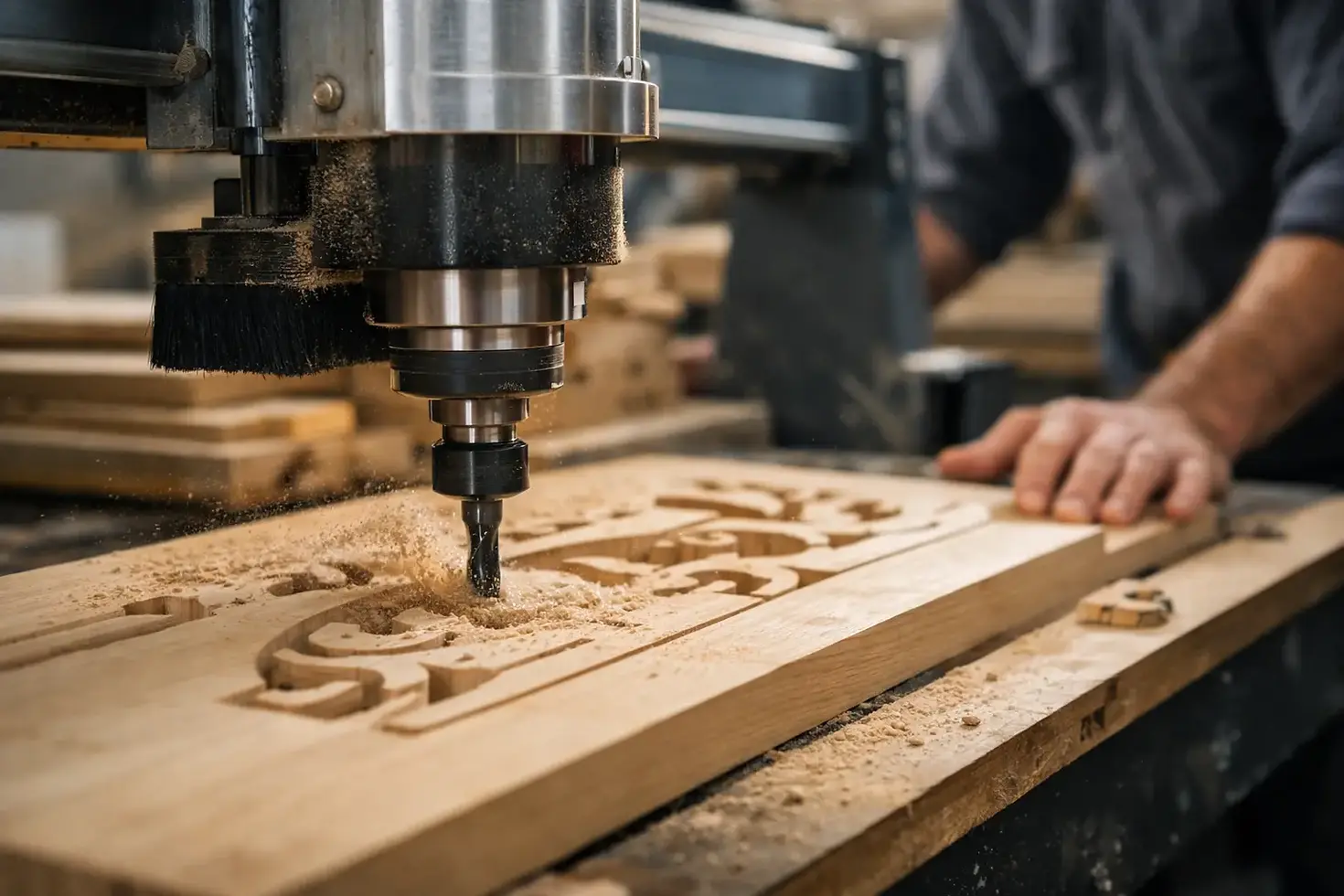
CNC Woodworking Cutting Services for Custom Work
A curved walnut bar front, a run of cabinets fitted to an old wall, or a precisely patterned room divider all begin with the same question: how do we make every detail fit exactly as intended? CNC woodworking cutting services give custom projects that level of repeatable precision while leaving room for the material knowledge, handwork, and finishing that make real hardwood work feel special.
At Bull Valley Custom Woodworks, CNC capability is part of a complete fabrication process, not a shortcut to generic parts. We use it to turn well-considered drawings into accurately cut components for homeowners, designers, contractors, and commercial teams. The result can be cleaner joinery, more consistent details, and a more efficient path from concept to finished piece.
What CNC Cutting Adds to Custom Woodwork
CNC stands for computer numerical control. In woodworking, it means a machine follows a programmed toolpath to cut, bore, carve, or shape a wood component with exceptional consistency. Once the design and setup are correct, the machine can repeat that operation across matching parts far more precisely than hand layout alone.
That matters when a project includes a set of identical cabinet doors, a group of decorative panels, a stair component with repeated shapes, or furniture parts that must align during assembly. It also matters when the design calls for geometry that is difficult to produce with conventional shop tools, such as flowing curves, nested cutouts, recessed lettering, intricate perforations, and complex joinery.
Precision does not mean every project needs CNC. A single live-edge slab countertop may benefit more from careful flattening, sanding, edge work, and a finish selected for its use. But when repeatability, detailed shaping, or exact component fit are central to the design, CNC can make a significant difference.
CNC Woodworking Cutting Services Start With the Design
The machine only cuts what it is instructed to cut. That is why the most valuable part of CNC work often happens before a bit touches the wood. We begin by understanding the finished application: where the piece will live, how it will be used, what material is appropriate, and what tolerances the installation requires.
For a custom kitchen, that may mean confirming appliance specifications, wall conditions, filler locations, hardware clearances, and the relationship between cabinetry and a hardwood countertop. For a commercial project, it may involve working from architectural drawings and producing millwork components that coordinate with other trades. For a custom table or bar top, the conversation may focus on proportions, grain direction, edge profiles, and the practical demands of daily use.
From there, drawings become machine-ready files. Toolpaths are planned around the right cutter size, cutting direction, material thickness, and the sequence of operations. A pocket cut, for example, may need to be routed before the piece is cut free from a larger panel. Through-cuts need proper hold-down methods so parts stay stable and edges remain clean.
This planning stage is where experience saves trouble. A digital drawing can be perfectly square while an existing home is not. Wood itself also moves with seasonal humidity. We account for real-site conditions and material behavior rather than treating a computer file as the entire project.
Material Selection Still Matters
CNC does not make all wood behave the same way. Oak, maple, walnut, cherry, ash, and specialty hardwoods each cut differently, show machining marks differently, and accept finishes in their own way. Veneered sheet goods, plywood, MDF, and solid hardwood also require different tooling and strategies.
A sharp bit and a well-built program help prevent tear-out, but grain direction still matters. So does the quality of the lumber. We select and prepare material with the final use in mind, whether we are fabricating durable cabinet components, decorative wall panels, closet parts, or a one-of-a-kind furniture piece.
Where CNC Precision Makes the Biggest Difference
CNC cutting is especially useful for custom cabinetry and built-ins. It can accurately produce cabinet sides, shelves, door components, drawer parts, hinge locations, and hardware drilling patterns. That consistency helps when multiple units need to align across a kitchen, mudroom, bath, office, or entertainment wall.
It is also ideal for architectural millwork. Decorative grille panels, wall cladding, custom trim profiles, column wraps, reception features, and branded commercial details often require a balance of visual impact and dependable repetition. CNC makes it possible to reproduce a design across many pieces while maintaining the dimensional control needed for installation.
Furniture projects benefit in a different way. A dining table base with curved legs, a bed frame with matching joinery, or a series of chairs with shaped components can be cut with a consistency that supports a stronger final assembly. The CNC machine handles the repeatable geometry, while our team sands, fits, assembles, refines edges, and applies the professional finish that gives the project its final character.
For contractors and remodelers, CNC services can also help solve the problem of unusual dimensions. Older homes rarely offer perfectly straight walls, square corners, or standard openings. Custom templates, scribed fillers, and made-to-fit parts often make the difference between a project that merely occupies a space and one that looks built for it.
CNC Is a Tool, Not a Substitute for Craftsmanship
There is a misconception that computer-guided cutting removes the human element from woodworking. In reality, it shifts skilled labor toward the decisions that have the greatest impact: design interpretation, material selection, machining setup, assembly, sanding, and finishing.
A CNC router can cut a repeated pattern with impressive accuracy. It cannot decide which walnut board has the right grain flow for a prominent cabinet face. It cannot feel a transition between parts and refine it until it is comfortable to the touch. It cannot judge how a finish will deepen the color of cherry or reveal the figure in a white oak panel.
The best projects use both forms of precision. Digital fabrication gives us control over the geometry. Hands-on woodworking gives the piece its strength, surface quality, and visual warmth. That combination is particularly valuable when a project needs to be exact without looking manufactured.
What to Bring to a CNC Woodworking Project
You do not need a fully finished CAD file to begin. A sketch, inspiration images, measurements, architectural drawings, or even a clear description of the problem can be enough to start a productive conversation. If you are a homeowner, it helps to know the approximate dimensions, intended use, preferred wood species or color direction, and any must-have functional details.
Trade clients can speed up the process by sharing specification drawings, quantities, material requirements, and installation dates. If a part must coordinate with stone, metal, glass, lighting, or existing cabinetry, include those dimensions early. Small details such as the size of a cable grommet, the setback for a drawer pull, or the location of concealed brackets are much easier to address before machining begins.
Be realistic about what needs to be exact and where flexibility is appropriate. A CNC-cut cabinet component can be held to a tight tolerance, but a wall-mounted installation may still need scribing or field adjustment. Likewise, elaborate patterns and complex toolpaths can add fabrication time. They are worthwhile when the design calls for them, but a simpler detail may deliver a similar visual effect at a more efficient cost.
From Cut Parts to Finished Installation
CNC cutting is one stage in a larger custom woodworking process. After parts are machined, they may need edge treatment, hand sanding, joinery work, dry fitting, assembly, stain matching, clear coating, and final inspection. A beautifully cut panel is not finished until its surface feels right, its edges are clean, and it performs as intended in the space.
That full-shop perspective is especially useful for projects that combine multiple operations. We can plane lumber, flatten slabs, resaw hardwood, CNC-cut components, sand surfaces, and apply professional finishes under one roof. Keeping these steps connected helps maintain quality from raw material to the completed piece.
Whether you are planning a custom kitchen, a statement dining table, detailed millwork, or specialty components for a larger build, CNC can bring accuracy to the parts that demand it. Bring us the idea, the dimensions, or the drawings, and we can help determine the right balance of technology, hardwood craftsmanship, and practical construction for work made to last.


Comments