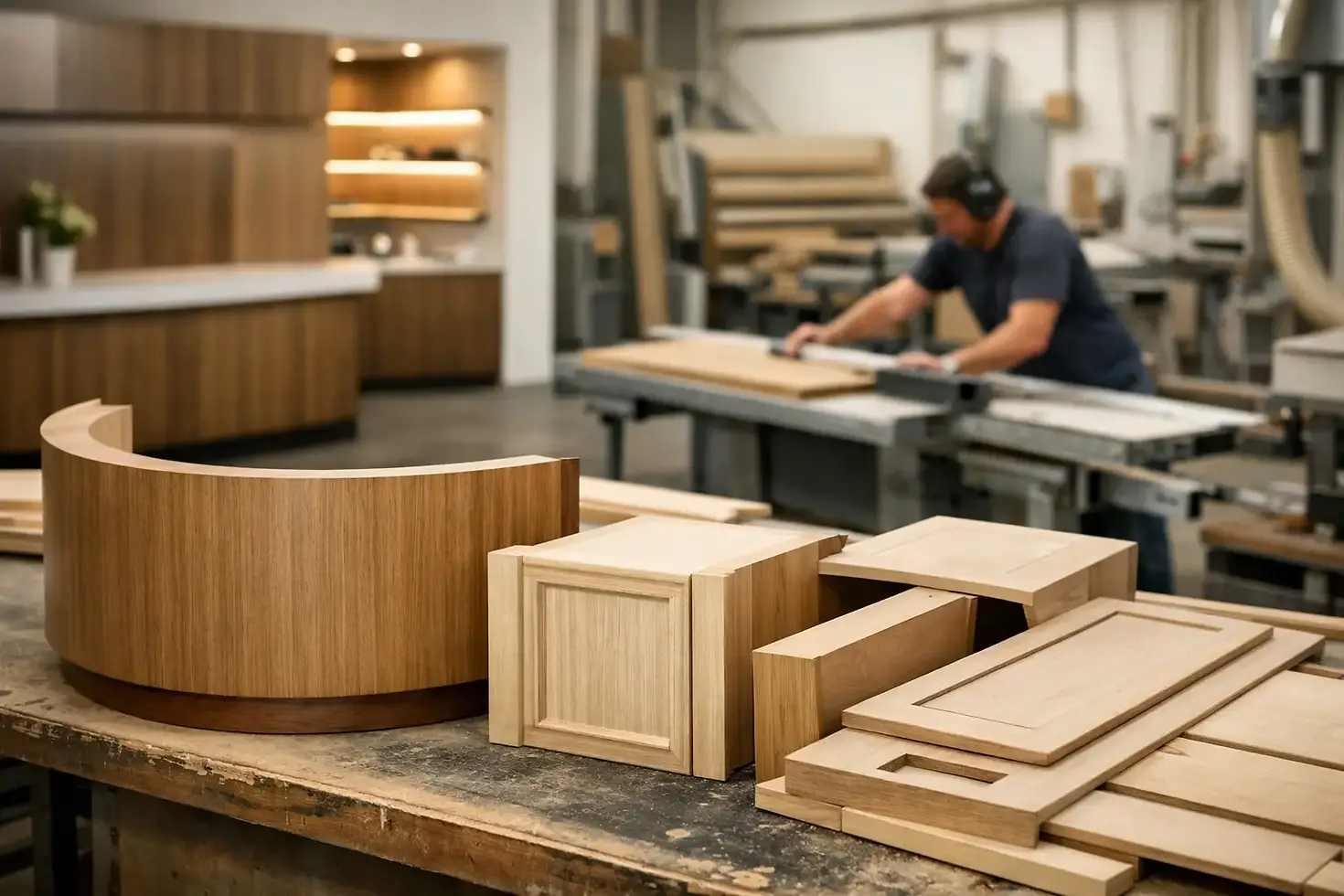
Architectural Millwork Fabrication Services
A room can have beautiful flooring, thoughtful lighting, and quality finishes, yet still feel unfinished when the woodwork is treated as an afterthought. The right architectural millwork fabrication services bring the details into focus: cabinetry that fits the wall instead of fighting it, trim that gives a room proportion, and wood components made to serve the people who use them every day.
At Bull Valley Custom Woodworks, we build those details from the raw material forward. That means considering the lumber, grain direction, joinery, finish, installation conditions, and the real demands of the space before fabrication begins. For a homeowner, that can mean a kitchen island that finally fits an unusual footprint. For a contractor or architect, it means a fabrication partner who can turn specifications into dependable, finish-ready work.
What Architectural Millwork Includes
Architectural millwork is custom woodwork built as part of a structure or interior environment. Unlike a freestanding table or chair, it is typically designed around walls, openings, ceilings, stairs, and built-in functions. It may be highly decorative, strictly functional, or both.
A project might include custom kitchen or bathroom cabinetry, fireplace surrounds, wall paneling, ceiling beams, baseboards, crown molding, casings, handrails, stair components, closet systems, bartops, reception desks, or built-in shelving. In commercial settings, millwork often shapes the customer experience through service counters, display fixtures, office cabinetry, restaurant bars, and specialty architectural features.
The common thread is fit. Stock products work best when a room is standard and the design is flexible. Custom millwork is the better answer when dimensions are unusual, a specific wood species or profile matters, or a finished space needs a level of detail that cannot come from an off-the-shelf box.
Why Fabrication Quality Shows Up in the Finished Room
Millwork has to look right from across the room and hold up under close inspection. A door reveal that drifts, a poorly matched veneer, an uneven finish, or a miter that opens with seasonal movement can distract from an otherwise excellent renovation. Those details are not accidents at the end of a job. They are usually decided much earlier, in material selection and fabrication.
Wood is a natural material, and it moves with changes in humidity. That is part of its character, but it requires informed construction. We account for grain direction, expansion, moisture conditions, and the intended use of each piece. A wide walnut countertop needs a different approach than a painted built-in, a solid-wood handrail, or a commercial reception counter exposed to constant traffic.
Professional finishing matters just as much. The finish should support the design while protecting the surface from the wear it will actually receive. A family kitchen, a bar top, and a statement wall panel each call for a different balance of color, sheen, repairability, and durability. There is no single finish that is ideal for every project.
Custom Does Not Have to Mean Complicated
A custom project should give you more control, not more confusion. The process begins by clarifying the purpose of the piece, the site dimensions, the surrounding materials, and the visual direction. From there, we can narrow the choices that have the greatest effect: wood species, construction style, door and drawer layout, edge profile, finish, and hardware preparation.
With access to more than 70 hardwood species, we can help clients compare options beyond the usual oak-versus-maple decision. Walnut can bring depth and warmth to a bar or floating shelf. White oak offers a calm, durable look that works well in contemporary and transitional homes. Maple provides a smooth, even canvas for clear or painted finishes. Hickory brings stronger movement and character. The best choice depends on the room, the desired color variation, budget, and how much natural grain you want to see.
Our Architectural Millwork Fabrication Process
Good millwork starts with a practical conversation. We want to know what the space needs to do, not only how it needs to look. A mudroom bench may need hidden storage and a surface that tolerates wet boots. A built-in entertainment wall may need ventilation, wire management, and precise alignment around a television. A commercial counter may need durable edges, accessibility considerations, and coordination with other trades.
Once the project direction is clear, we develop the fabrication plan around accurate measurements and approved specifications. For trade clients, this means working from drawings, details, material callouts, and site requirements. For homeowners, it means translating an idea, inspiration image, or renovation plan into details that can be built and installed with confidence.
In the shop, our capabilities let us control more of the work under one roof. Widebelt sanding supports consistent surface preparation. Planing, hardwood resawing, and slab flattening help us prepare material correctly before it becomes a finished piece. CNC and laser services add precision where repeatability, detailed layouts, or specialized components are required. Just as important, experienced hands guide the work at every stage, because a machine can cut a shape but cannot make every design judgment for the project.
Fabrication is followed by careful sanding, finishing, and preparation for delivery or installation. Communication remains part of the work. On larger renovations and commercial projects, timing matters. We coordinate closely with contractors and project teams so millwork arrives when the site is ready for it, rather than becoming one more variable on a crowded schedule.
Where Custom Millwork Makes the Biggest Difference
Kitchens are an obvious place to invest, but they are not the only one. Custom cabinets can solve a difficult corner, align with an existing window, or create storage around appliances with nonstandard dimensions. A hardwood island top or countertop can give the room a surface with warmth and presence that manufactured materials cannot duplicate.
In living spaces, built-ins can turn an underused wall into useful storage without making the room feel heavy. The difference often comes down to proportion: shelf depth, cabinet height, face-frame details, spacing around a fireplace, and how the piece relates to nearby trim. Those are details worth planning before construction starts.
Stairways also benefit from thoughtful custom work. Handrails, newel posts, treads, and trim are touched and seen every day. They need to be comfortable, code-conscious, durable, and visually connected to the rest of the home. A well-made stair component can be a quiet detail, or it can become the feature that gives an entry its identity.
For businesses, custom millwork often carries the brand in a physical way. A reception desk, bar front, display wall, or service counter should fit the workflow behind it as well as the image in front of it. Commercial work adds practical considerations such as durability, maintenance, coordination, and production schedules, which is why specification-driven fabrication is so valuable.
When to Choose Custom Instead of Stock
Custom fabrication is not automatically the right choice for every portion of every project. Stock cabinetry and trim can be efficient when the layout is straightforward, the budget is tight, and the available options genuinely fit the design. The value of custom work rises when compromise would remain visible or create daily frustration.
Choose custom millwork when you need to use an awkward space, match existing architectural details, achieve a particular material or finish, integrate specialized storage, or create a focal point with real longevity. It is also the stronger route when a project needs an unusual size, a distinctive edge treatment, or craftsmanship that will carry through the entire room.
The goal is not to make everything more elaborate. It is to put craftsmanship where it makes the most difference, then build it with materials and construction that deserve to stay in the space for decades.
If you are planning a renovation, a new build, or a commercial interior with details that deserve more than a standard solution, bring the idea to the shop early. We can help shape it into woodwork that fits the room, works hard, and gives the finished space a character that is unmistakably yours.


Comments